
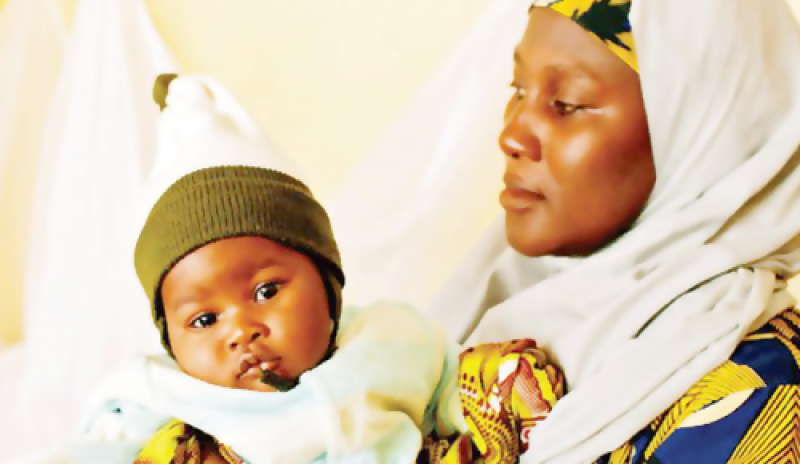
The federal government, through the Midwives Service Scheme, Subsidy Reinvestment Programme, and maternal and child health care, has deployed thousands of community and village health workers now being trained and deployed to different parts of the country.
As written, with photo, by WINIFRED OGBEBO on June 10, 2013 in Leadership - www.leadership.ng"As Nigeria commemorates ‘Safe Motherhood’ today, WINIFRED OGBEBO writes on efforts being made to save more women from pregnancy-related deaths and the progress so far.“I went to Oron General Hospital in Akwa Ibom. I was told less than 10 per cent of pregnant women actually come to use the facilities to deliver. Some of them deliver at home, or go to faith-based places to deliver, and when complications arise, there is nobody to help and it will be a prophecy. Those are demand side issues,” this account narrated by the Minister of State for Health, Dr Muhammad Ali Pate, captures succinctly, the women’s choices for health care services However, the president of the Association for Reproductive and Family Health, Prof Oladapo Ladapo, said the present maternal mortality rate has greatly reduced from the initial 545/100,000 to a striking figure of 350/100,000 as recently released by the MDGs’ office. The Executive Director, National Primary Health Care Development Agency (NPHCDA), Dr Ado Mohammed, said that though Nigeria is making progress towards the MDGs, progress does not equate to success.Ado said, “If we have to get to our figure of 250/150,000 by 2015, we have a lot of work to do.”Last year, President Goodluck Jonathan flagged- off the Save- One- Million- Lives Initiative. He said by 2015, it is possible for Nigeria to save one million lives of women and children from preventable causes of morbidity and mortality, and that it would entail a partnership between federal, states, local governments and private sector and the civil society to actualise this.Maternal mortality is not inevitable: when there is effort to provide care for a woman, stop her from bleeding and detect infection when it happens, one is able to save the lives of women.Pate said, “Whatever government does, people have to be ready to believe. Preventing mother-to-child transmission is what took me to Akwa Ibom, but I am told even if women are tested positive, they say it is witchcraft. They will not go get the drugs to prevent the transmission. In every part of the country, there are some of these demand-side issues. We have to raise the awareness of the people. Some of these things are not inevitable. We can do some things to prevent them from happening.”However, Pate said, along with rehabilitation of PHCs, provision of basic health commodities, in 2012, the monitoring report showed at least one million women attended antenatal care in facilities where FG had intervened, adding, “That does not include other women who may have attended existing facilities in their respective states.” He added, “There are challenges in financing. PHC is the best way to go but it is also not cheap. You have to put in resources to buy the vaccines, put in cold chain infrastructure and have qualified human resource. Nigeria has moved but not yet where we can say we have gotten everything all in order. We have to continue to push toward further progress until 2015, and Saving One Million Lives is a good initiative, because it is no longer about the drugs people take, but about the results. “And in order to drive demand for health care services, about two months ago, the federal government officially launched the conditional cash transfer scheme for pregnant women in the country.Under the scheme, any pregnant woman who registers, visits and delivers at any Primary Health Care centre is entitled to N5, 000. The federal government, through the Midwives Service Scheme, Subsidy Reinvestment Programme, and maternal and child health care, has deployed thousands of community and village health workers now being trained and deployed to different parts of the country. Pate argued that human resources, essential commodities and the demand side, needs to be strengthened. “The area we feel should be focused on is maternal and child health, skilled birth attendants, antenatal care and postnatal visits.”He maintained that the reduction seen in maternal and child mortality is coming from very simple cost-effective interventions, not even at hospitals but at the primary health centres and also in the general population. “They are immunising our children, breastfeeding them, supplementing their nutrition, ensuring that zinc and ORS become available and for pregnant women to go for antenatal care. We are seeing increase in ANC and skilled birth attendance, and if there are complications to refer them.”“We have done that with MSS and now with SURE-P and seen recognition that that is the way to go. These simple interventions don’t need big hospitals, CT scan or MRIs or sophisticated drugs. They are simple things and it is by doing them that we have accelerated Nigeria’s progress in reducing maternal and child mortality using the platform of primary health care system.” “If you compute all FG interventions, maternal and newborn child health weeks, MSS, SURE-P, immunisation, we estimate that at least, 218,000 lives would have been saved in 2012 that can be attributable to those interventions. Without this way of thinking, you will not be able to appreciate.”For instance, the Minister of Health, continued, “if you have measles outbreak, it could have been 200,000 cases. In 2009, remember there were 25,000 cases of meningitis. This year, we had less than 1,000, and people don’t pay attention to that. Assuming there was no vaccination and you had 100,000 cases, everybody will be on top of it. It is time to quantify and attribute some of this. It is not scientific and precise as we want to be but it is a way of conveying the import of what we are trying to do—saving lives and preventing disease”.The second aspect, he noted, is routine immunisation. “There are maternal newborn and child health weeks twice, which immunises millions of Nigerian children but also give them vitamin A, teach their mothers about breastfeeding, distribute bed nets and prevent mother-to-child transmission.However, Oladapo added that some regions still have reasonable high maternal deaths which he explained, was due to the inequitable distribution of health professionals in some states.He advised that for the present progress to be sustained, the federal government needs to make a deliberate policy to ensure that doctors provide services in areas their services are critically needed, adding that such a deliberate policy would allow doctors harness their skills, expose them to present trends in medicines and also act as an important part of their training as gynaecologists and obstetricians.For the life-saving commodities—misoprostol, chlorhexidine, zinc oral rehydration salts, disposable ampicillin for paediatric age groups, the minister disclosed that there are efforts to prequalify them so zinc and oral salts become available for Nigerian children.“Health is a concurrent matter. What federal government is doing is setting directions, facilitating regulatory approvals, demonstrating that these things can work and encouraging states to take it up. Even after we have bought, in the long run, we want the states to be buying for themselves.”