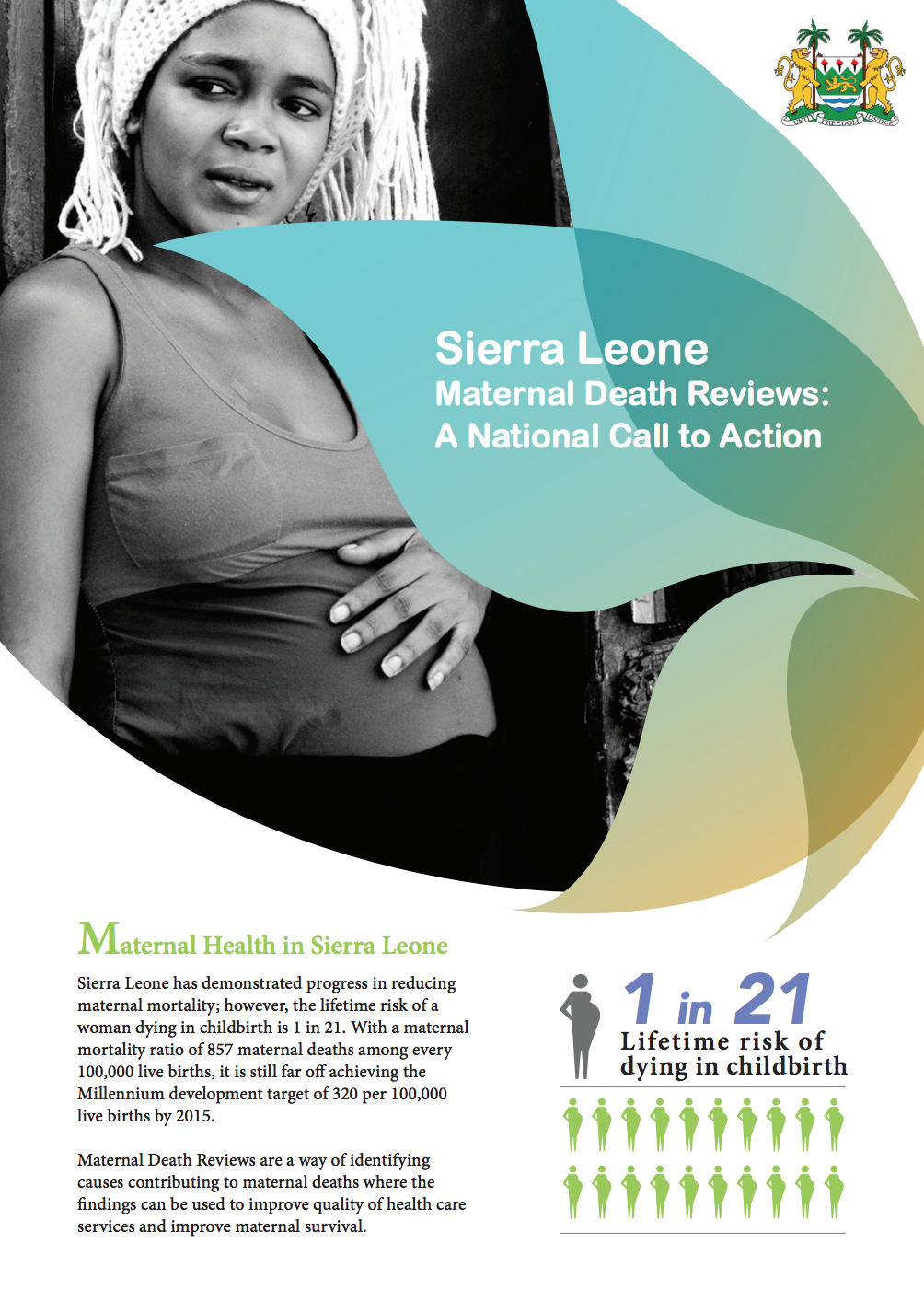
Sierra Leone Maternal Death Reviews 2011: A National Call to Action
Maternal Health in Sierra Leone
Sierra Leone has demonstrated progress in reducing maternal mortality; however, the lifetime risk of a woman dying in childbirth was 1 in 21 in 2011. With a maternal mortality ratio of 857 maternal deaths among every 100,000 live births (DHS 2008), it is still far off achieving the Millennium development target of 320 per 100,000 live births by 2015.
Maternal Death Reviews are a way of identifying causes contributing to maternal deaths where the findings can be used to improve quality of health care services and improve maternal survival.
Since the start of the Free Health Care Initiative in April 2010, more pregnant women, lactating mothers and children under five years old are accessing health care. For example, the number of deliveries recorded in facilities has increased four-fold since 2009 to 11,800 in 2011.
Although the proportion of maternal deaths in facilities has decreased since 2009, a key challenge that still remains is to improve the quality of care. One way to do this is through maternal death reviews (MDRs).
What is a maternal death review?
“This information can help to identify the root causes to prevent further deaths from the same causes on an action that can be followed up.”
Most maternal deaths are avoidable. Maternal Death Review involves an in-depth investigation of the causes and circumstances surrounding a maternal death. It captures information about the number of maternal deaths and circumstances surrounding each death.
This information can to help identify the root causes to prevent further deaths from the same causes based on actions that can be followed up.
“Without information, there can be no action.”
Benefits of MDRs
Health facilities or communities examining each maternal death through a systematic approach can lead to the following benefits that can inform appropriate non-punitive actions:
- Establish the number and causes of deaths for action
- Identify gaps in service delivery and improve professional practice and training
- Better understanding of community barriers and challenges
- Gain insight into the health system failures and weaknesses for action
- More efficient management of resources.
Findings from a nation-wide MDR
In total, only around 10% of all maternal deaths across the country (224 among an estimated 2,050)were reported in 2011 through the facility-based MDR system from 13 district hospitals.
Key characteristics of the maternal deaths:
- The deaths occurred among women between 13 years and 48 years; more than a fifth of them (21%) were under 19 years of age.
- A third of women were pregnant for the first time.· Most women (71%) were in their third trimester of pregnancy at the time of death.
- Only a third (34%) of women were known to have a history of antenatal care attendance.
- Most of the women (60%) died during the postnatal period, and almost half of those died within the first 10 days, particularly within the first 48 hours.
The three main causes of reported maternal death were:
- Haemorrhage (34%) accounted for over a third of all maternal deaths.
- Eclampsia (23%) accounted for over a fifth of all deaths.
- Puerperal sepsis (19%) accounted for nearly a fifth of maternal deaths.
Strategic recommendations & next steps
Supportive legislation on MDR should be passed to ensure the process is seen as non-punitive action.
- Strengthening of blood services, especially increasing availability of blood.· Strengthening referrals at all levels of care.
- Establish database that can contribute towards more complete and comprehensive analysis.
- Ensure actions are taken based on findings of MDRs by government and partners.
- Strengthening adolescent friendly health service delivery with emphasis on programme targetingteenage pregnancies.
- Strengthening advocacy at all levels with emphasis on increasing budget allocation to undertake MDRprocess and act on findings.
- Strengthening community advocacy and sensitisation activities with emphasis on danger signs, servicedelivery and prompt referral to a facility.
- Community MDRs should be incorporate into the national MDR process as a means of capturing more information about maternal deaths.
Ministry of Health and Sanitation, and Evidence for Action. (2012). Maternal deaths reviews. A national call to action. Freetown: MoHS