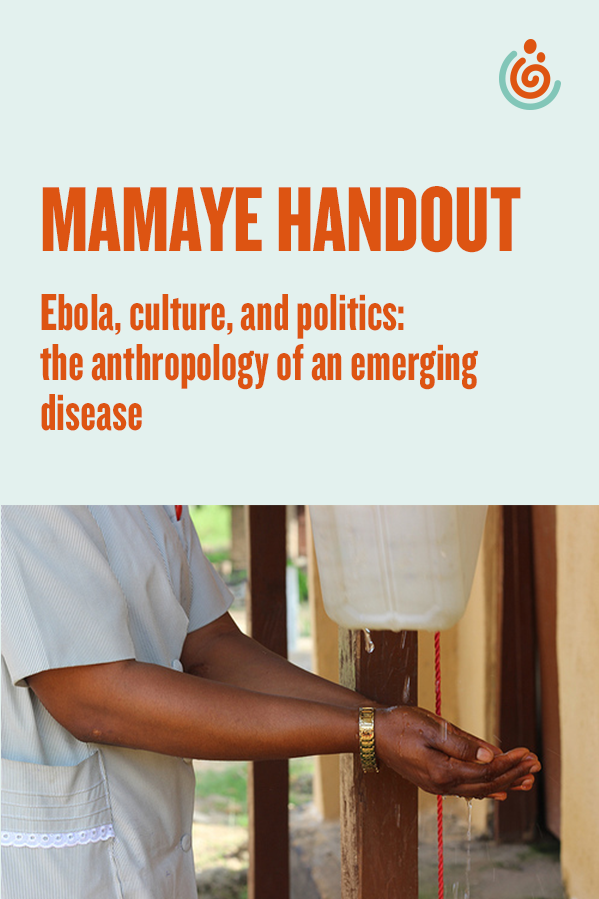
Ebola, culture, and politics: the anthropology of an emerging disease
This is a handout by MamaYe about lessons learnt on outbreak control to support implementers in the fight against Ebola.
This case study offers medical anthropologists’ perspectives to understandings of Ebola during two outbreaks.
In particular, it provides details on the thoughts, feelings, explanations, and responses to Ebola among the people who experience these outbreaks.
It is co-authored by the first anthropologists to be invited by the World Health Organization to be involved in Ebola control.
Drawing upon a variety of case studies from Central Africa, particularly Uganda in 2000-2001 and Congo in 2003, the authors argue that public health responses to future Ebola outbreaks can be strengthened by integrating the attitudes and practices of local people into control procedures.These include an awareness and understanding of both health-enhancing and health-lowering beliefs.
The key findings and recommendations, based on the outbreaks studied by the authors, are summarised below.
Key findings
- Local people have their own beliefs, concepts, and cultural models for epidemic illness. They use specific protocols to control it and are often willing to help with control efforts. These practices can contribute to control the outbreak.
- Some of the local beliefs and practices are neither health-lowering nor health-enhancing in Ebola outbreaks and need not be modified. These include use of protective objects, and ritual activities to deter spirits. Some beliefs and practices such as traditional funeral practices can amplify the Ebola outbreak and should be modified.
Key recommendations
National, district and local authorities
- Authorities should restrict traditional burial and funeral practices, transportation of sick family members, and consumption of game animals during the outbreak. These traditional practices can amplify Ebola outbreaks.
- Communities impacted by Ebola need assistance during outbreaks because stigmatisation can lead to a loss of financial resources.
Health decision-makers, management teams and workers
- Health decision-makers, planners and workers should be informed about local concepts, explanations, and control strategies for epidemic illnesses in a community. If they know about local concepts, they should be encouraged to use this knowledge to better adapt control efforts. Health workers should show understanding of these beliefs in order to establish a good relationship with the community. Health planners should ensure intervention strategies are flexible and adaptive to the context.
- Health educators should integrate local interpretations of disease causality and transmission in their health messaging – for instance, they should use local terms and concepts for epidemic disease. This may help to build trusting positive relationships with the community.
- When the disease is seen to be caused by sorcery, health educators should identify local criteria that distinguish sorcery (not transmitted by touch) from epidemics and use this in their messaging to prevent the spread of the epidemic.
- Health workers should be aware that local activities may be health-enhancing in some contexts and health-lowering in others. Steps can be taken to optimise the contribution of three specific areas:
Traditional healers must be provided with health education and protective equipment. In areas where sorcery is prevalent, international organisations should not actively include healers in control efforts
Fear and rapid spread of information: Frequent, accurate and clear information about Ebola must be delivered by health workers and local leaders to help reduce fear. Corrections of misinformation must be communicated rapidly
Local peoples’ familiarity with other deadly infectious and parasitic diseases: It is important to recognise that the health care priorities of local people may be different to those of international health worker
The community is eager be involved in disease prevention and health planners can work with communities and especially children to help control the disease.
- Communities often want to provide assistance in control efforts and are surprised that intervention teams rarely engage with them or ask for their support. Local people should therefore be seen as allies rather than barriers to control efforts.
- Examples of positive assistance of the community can include disease surveillance (e.g. reporting suspect cases), health education, and social mobilization.
Children under 15 often comprise around half of the population of Ebola-affected communities in Africa. Children can be used as a vehicle for implementing positive interventions. They areless likely than adults to use sorcery as an explanation for illness. Health educators should therefore encourage children to discuss these ideas with their family and use children as a means to inform older generations.
- Health workers should also build upon the perception that children are at greater risk to epidemic disease than adults to help protect children.
- Caution should be used in some contexts in directly involving traditional healers with prevention efforts, as they can continue to promote sorcery explanations and unwanted solutions.
Health educators should explain the importance of refraining from traditional burial and funeral practices, transportation of sick family members, and consumption of game animals during the outbreak. They should also target traditional healers, provide them with protective equipment and encourage them to refer cases.
- Burial and funeral practices – a proper burial is an important element of African life and health workers should show support to families e.g. by attendance at funerals. Members of the family should always be allowed to see the deceased before burial. Ideally, burials should be carried out by trained teams who could include a family member of the deceased; when this is not possible, families should be provided with bleach, gloves, and other protective equipment. Protective measures can also be integrated with other funeral practices e.g. use of bleach in the communal washing of hands.
- Transportation of sick family members – trained health teams should use vehicles to transport sick people to a clinic/hospital for care. This will help prevent infection of the people who take individuals for care by bicycle.
- Consumption of game animals – local people should be encouraged not to touch or consume any dead game animals they find in the forest and should not consume gorilla or chimpanzee meat. It may be unnecessary to ban the consumption of all game meat due to local peoples’ dependency on this for protein and the suspicion that this may cause of public health officials.
Transparency is extremely important to prevent suspicion and distrust of international health workers and can help promote positive, productive relationships between INGOs and communities.
- Transparent approaches can include regular public community meetings, informal interaction with and recognition of the local people, and involving family members in healthcare decisions. Isolation units should be surrounded with a picket fence rather than tarpaulin to make them more visible to family members.
- Transparency and positive relationships will help to encourage acceptance in the community that Ebola exists. Denial of its existence is relatively common and may arise due to distrust of international involvement, beliefs in sorcery, or the anxiety about the social and financial costs of stigmatisation.
Women should be targeted during prevention efforts.
- Ebola infection and outbreaks are strongly gendered. The risk of infection and death is higher among women; in the 2000-2001 Uganda outbreak the proportion of Ebola cases was higher among women than men at all age-groups except 0-9 years.
- This is because women are more likely to care for the sick and to prepare deceased bodies for burial.
- Health educators should ensure that messaging reflects this increased risk and that information reaches women e.g. via women’s group meetings.
Health workers need on-going training and access to resources such as barrier-nursing supplies to help control the outbreak.
- The importance of incorporating these kinds of anthropological research-based recommendations is underlined by the WHO report Communication for behavioural impact. The report emphasises that ‘a one-size-fits-all response’ is not sufficient in responding to outbreaks and that ‘the response must be adjusted to local conditions’ (p.6)
Handout based on the following publication: Hewlett, B. S., & Hewlett, B. L. (2007). Ebola, Culture, and Politics: The Anthropology of an Emerging Disease. Belmont: Thomson.